
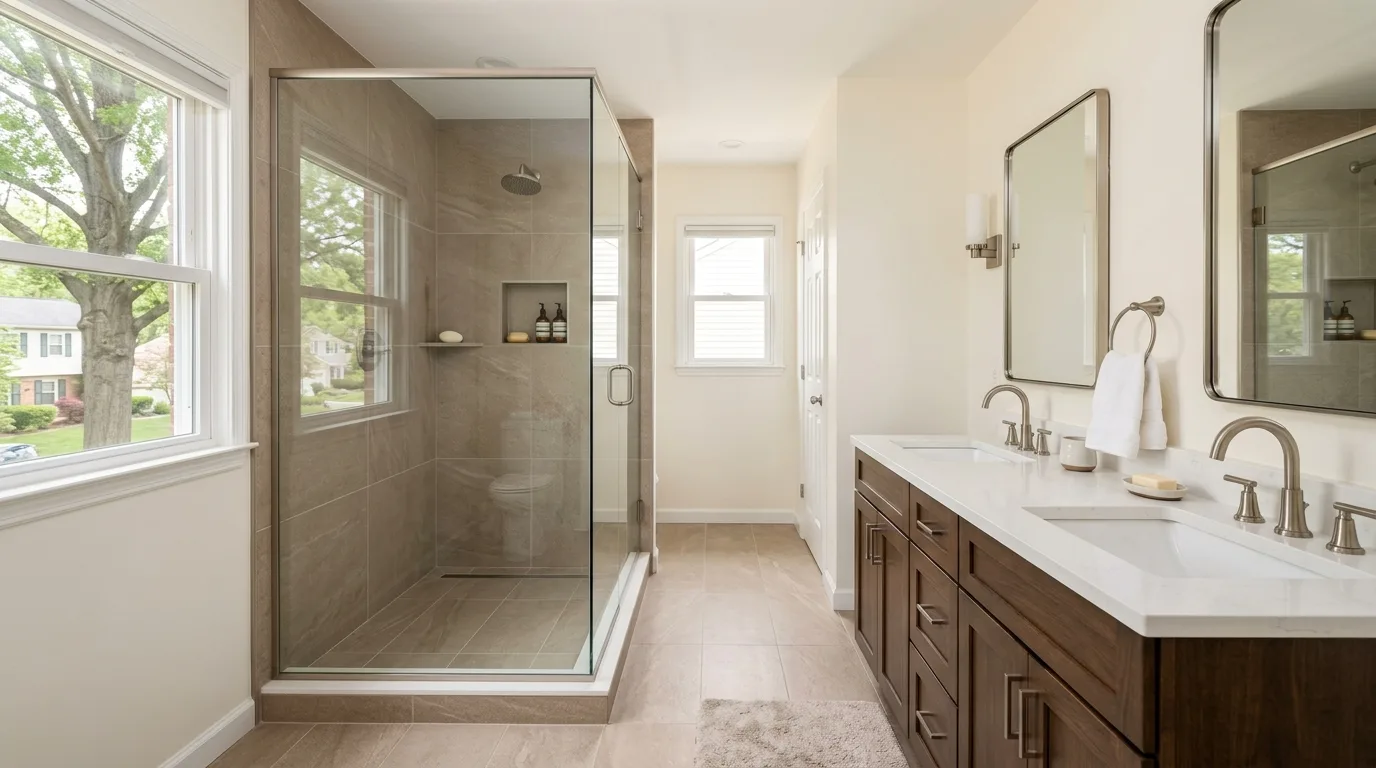
Gaithersburg is one of the more straightforward places in Montgomery County to remodel a bathroom, for a reason that has nothing to do with the houses: the city runs its own permit office, and it publishes its fees and timelines clearly.
That’s more useful than it sounds. When you know the fee structure and the review window in advance, you can plan the project around them instead of waiting to find out.
Here’s what bathroom remodeling in Gaithersburg actually involves, from the permit desk to the last tile.
The Gaithersburg permit specifics
If your address is inside city limits, your permit comes from the City of Gaithersburg, not Montgomery County DPS. The city runs its own program covering building, electrical, mechanical, fire systems, grading and stormwater within its boundary.
For a bathroom remodel, the relevant one is a Residential Improvement Permit — the same category that covers finishing a basement, remodeling a kitchen, converting a room to a bedroom or enlarging a window or door opening.
Two published figures worth planning around:
- Fees start at a $50 minimum, rising to a $375 minimum once project cost exceeds $20,000.
- Review time for routine residential work typically runs two to four weeks. Complex projects take longer.
That two-to-four-week window is the number to build your schedule around. It’s not dead time if you use it — that’s exactly when to be ordering tile, fixtures and the vanity so materials are on site before demolition starts.
As always: interior cosmetic work — paint, a like-for-like vanity swap, new fixtures in place — generally doesn’t need a permit. Anything structural, or touching electrical, plumbing or HVAC, almost always does.
What a Gaithersburg bathroom typically costs
Published market ranges for Maryland put a full bathroom remodel — new tile, vanity, fixtures, and a tub or shower replacement — at roughly $12,000 to $28,000. DC-metro data for 2026 puts the average near $19,000, with most projects between about $9,500 and $27,000.
By area, standard work runs about $150 to $400 per square foot, most commonly around $300. A cosmetic refresh can start near $5,000; a primary suite with custom tile and glass can pass $60,000.
Those are sourced market ranges rather than our pricing — we quote after seeing the room. Add the permit fee on top, and note that crossing the $20,000 project-cost line moves you into the higher minimum fee bracket.
What Gaithersburg’s housing stock means for the work
Gaithersburg spans a wide range — older sections of the city near the historic core, extensive 1970s and 80s development, and a lot of 1990s-and-later construction in the Kentlands and beyond. The era of your house predicts the surprises fairly well.
Newer construction (1990s onward): generally the easiest bathrooms to work in. Modern framing, accessible plumbing, adequate electrical. The issues here are usually about quality of the original finish work rather than the systems — builder-grade tile set without proper waterproofing behind it is the classic. It looks fine for fifteen years and then the grout starts telling on it.
1970s–80s: fibreglass tub-shower surrounds nearing the end of their life, undersized or poorly vented exhaust fans, and original vanities that were never intended to last this long. Occasionally polybutylene supply lines, which are worth identifying while a wall is open.
Older sections: mortar-bed tile that fights demolition, cast iron waste lines, and the ever-present possibility of a subfloor that has been quietly damp around the toilet flange for years.
The exhaust fan problem, which is everywhere
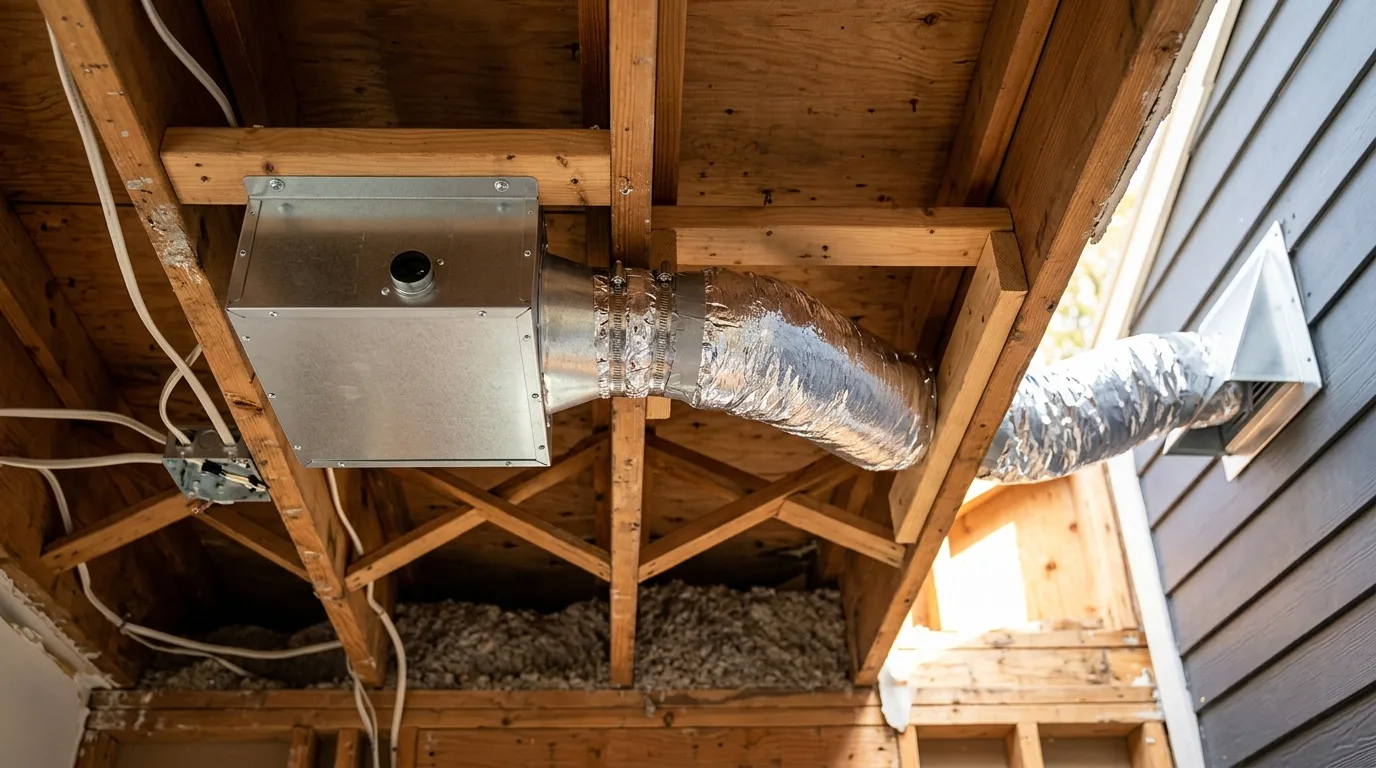
The single most common defect I find in bathrooms across this whole area, regardless of the age of the house: the exhaust fan vents into the attic instead of outside.
It passes casual inspection because the fan works — you can feel the air moving. It just moves the moisture from your bathroom into your roof structure, where a Maryland summer does the rest. Damp sheathing, then mould, then a much larger bill.
While the ceiling is open during a remodel, correcting this is inexpensive. Left alone, it’s the sort of thing that turns up in a home inspection years later attached to a number nobody enjoys.
Sizing matters too. An underpowered fan in a Maryland August isn’t clearing anything. Get this right once and you’ll never think about it again.
The sequence, and what can’t be compressed
- Permit filed — start here, because of that two-to-four-week review.
- Materials ordered and delivered — during the review window, not after.
- Demolition — usually a day. Where the surprises appear.
- Rough plumbing and electrical — fixture positions set, venting run to the outside.
- Inspection — nothing gets covered before sign-off.
- Waterproofing and backer board — invisible, and the whole job depends on it.
- Tile — set, cure, grout. The cure is not negotiable.
- Vanity, fixtures, glass, paint, punch list. Custom shower glass is measured after tile, so allow a week or two for it.
Realistically two to four weeks of work, on top of the permit review. Anyone quoting a permitted full bathroom in one week has left something out.
Three decisions to make before demolition, not during
Tub or shower. Only full bath in the house? Keep a tub — resale and small children both care. Second or third bathroom? A walk-in shower is usually the better room. Converting means moving the drain, which means permit.
Tile format. Large tiles mean less grout to clean but demand a flatter substrate and more prep. Small mosaics on a shower floor give grip and drainage but more grout lines. Different maintenance, neither wrong.
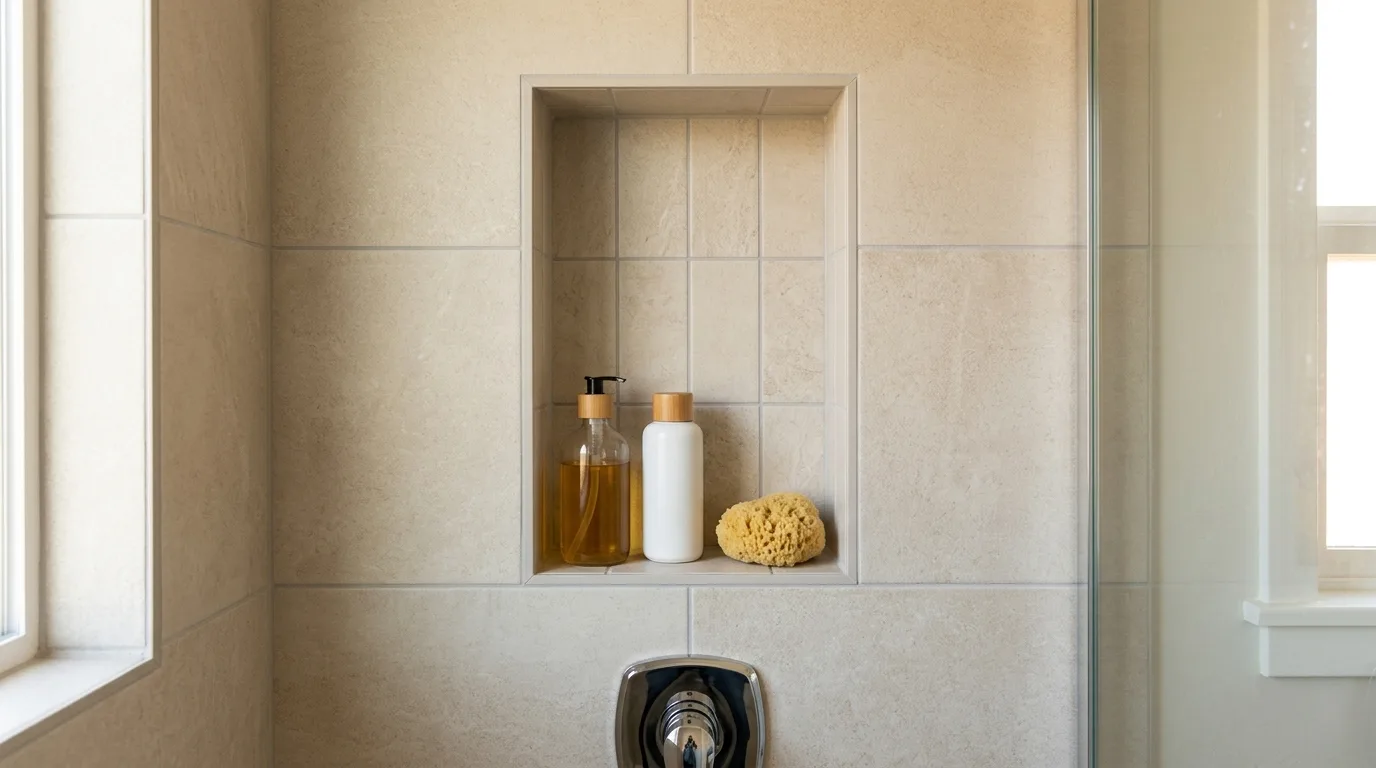
Storage. The most common regret I hear isn’t about tile, it’s about having nowhere to put anything. A recessed niche in the shower and a vanity with real drawers cost very little at the framing stage and are expensive to add later.
Getting a number for your bathroom
I can’t price a bathroom properly from photos, because the things that move the number are behind the tile. What I want to see: the age of the house, where the fan actually vents, the condition of the floor around the toilet, the supply lines, and whether the layout is staying put.
We do bathroom remodeling throughout Gaithersburg and the wider county, and estimates are free with no obligation attached. The Gaithersburg page lists everything else we handle locally.
And if your bathroom mostly needs a properly vented fan, a new vanity and fresh paint rather than a remodel, that’s a real answer and I’ll give it to you.
Bathroom Remodeling in Gaithersburg: The Short Version
Bathroom remodeling in Gaithersburg goes through the city’s own Residential Improvement Permit, with published fees and a two-to-four-week review you can plan around. Use that review window to get materials on site, and fix the exhaust venting while the ceiling is open.
Frequently Asked Questions
Q: Who issues bathroom permits in Gaithersburg?
A: The City of Gaithersburg runs its own permit and inspection program inside city limits. A bathroom remodel falls under a Residential Improvement Permit.
Q: What are Gaithersburg permit fees and review times?
A: Published fees start at a $50 minimum and rise to a $375 minimum once project cost exceeds $20,000. Routine residential review typically takes two to four weeks, which is the window to use for ordering materials.
Q: How much does a bathroom remodel cost in Gaithersburg?
A: Market ranges for Maryland put a full bathroom at roughly $12,000 to $28,000, or about $150 to $400 per square foot, most commonly near $300. A cosmetic refresh can start around $5,000. These are published ranges rather than our pricing.
Q: Why does my bathroom get damp even with the fan running?
A: Very often the fan vents into the attic instead of outside. The fan works, so nobody questions it, but the moisture goes into your roof structure. It’s inexpensive to correct while the ceiling is open.
