

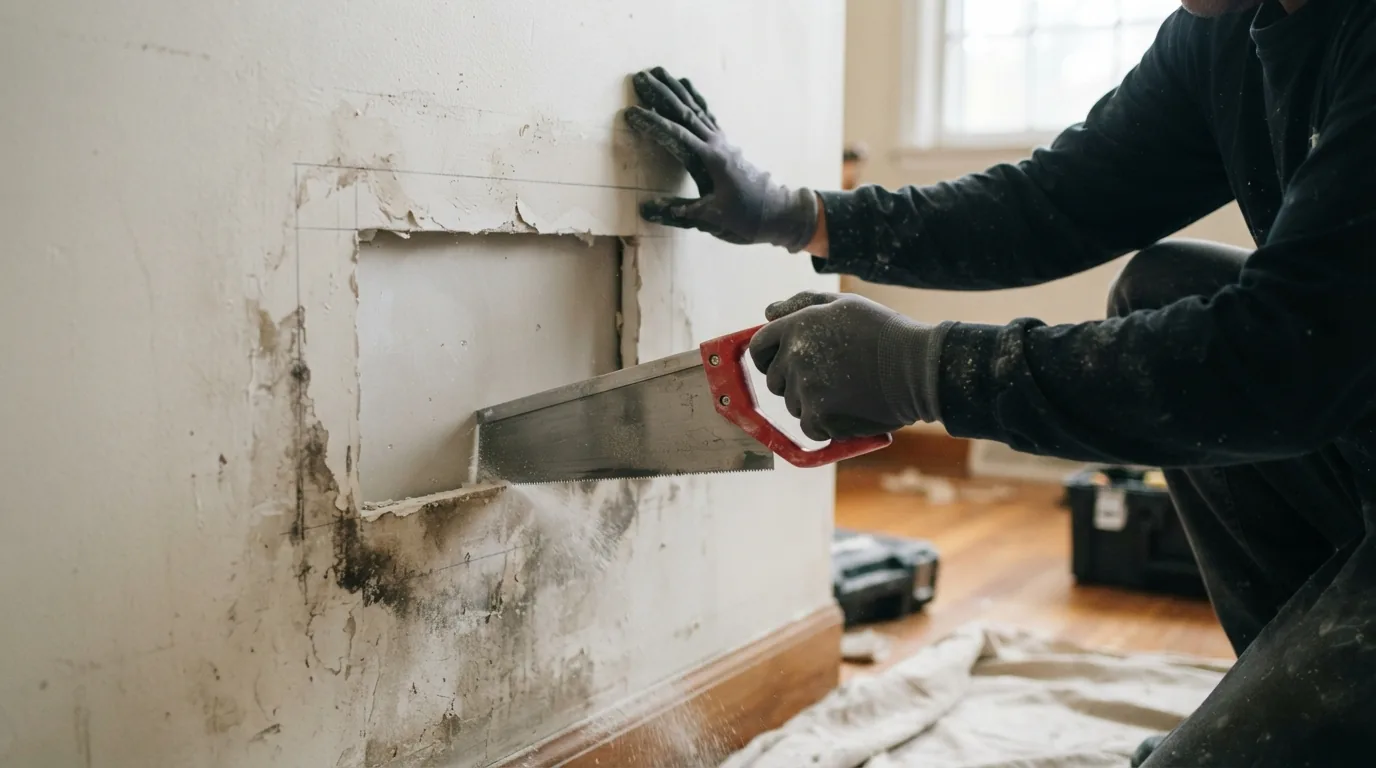
There are only three answers to a damaged wall. You patch it, you cut in a piece, or you take the sheet off and start again. Everything else is a variation on those.
Most of the disagreements I have with homeowners about drywall repair in Montgomery County come down to which of the three a wall actually needs — because the cheapest-looking option is frequently the one you pay for twice.
The three options, and what decides between them
Patch
For holes up to roughly fist-sized, and for dents, dings and anchor holes. A mesh or metal patch bridges the gap, compound goes over it in thin coats, and the whole thing disappears under paint.
Cheap, fast, and the right answer far more often than people expect. The limit isn’t really size — it’s whether the surrounding drywall is sound. A patch relies on the material around it to hold everything flat. If that material is soft, crumbling or wet, a patch has nothing to grip and you’re building on sand.
Piece in
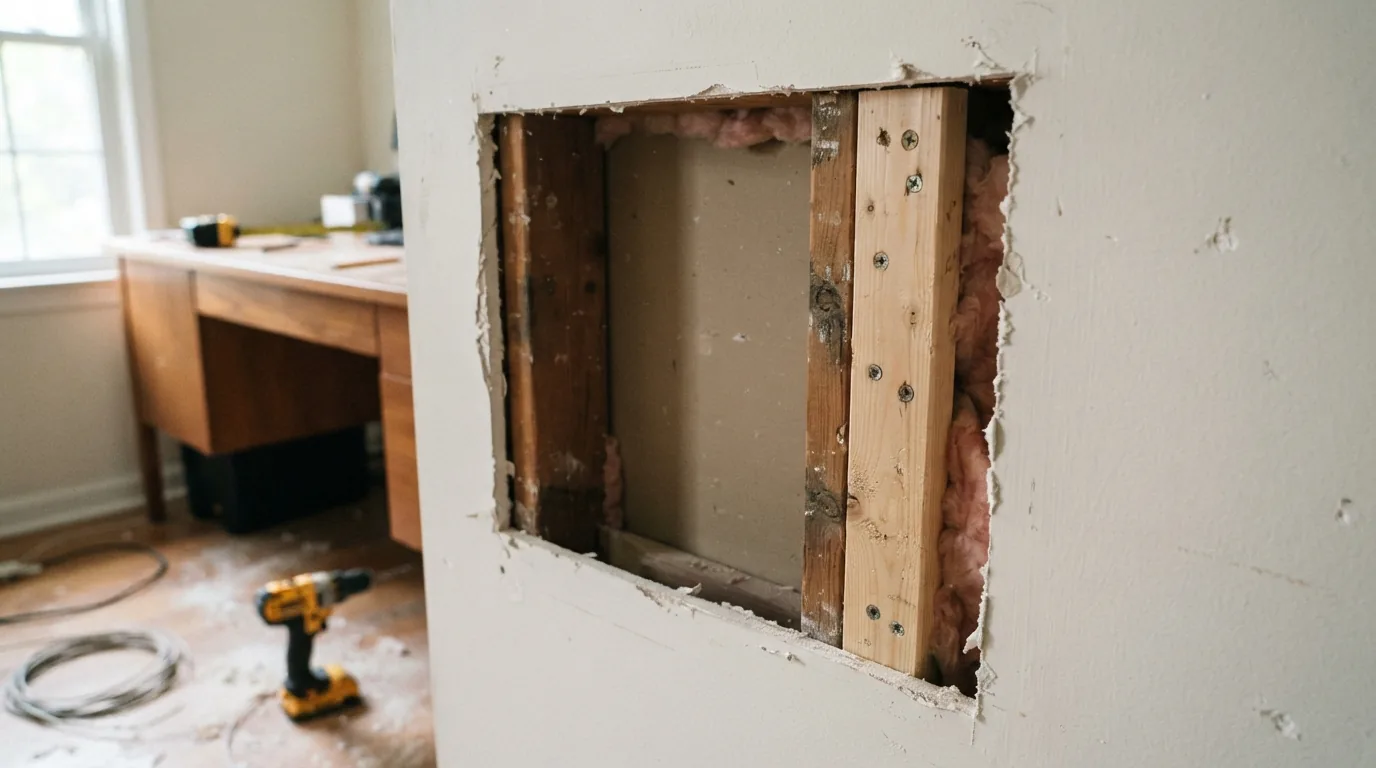
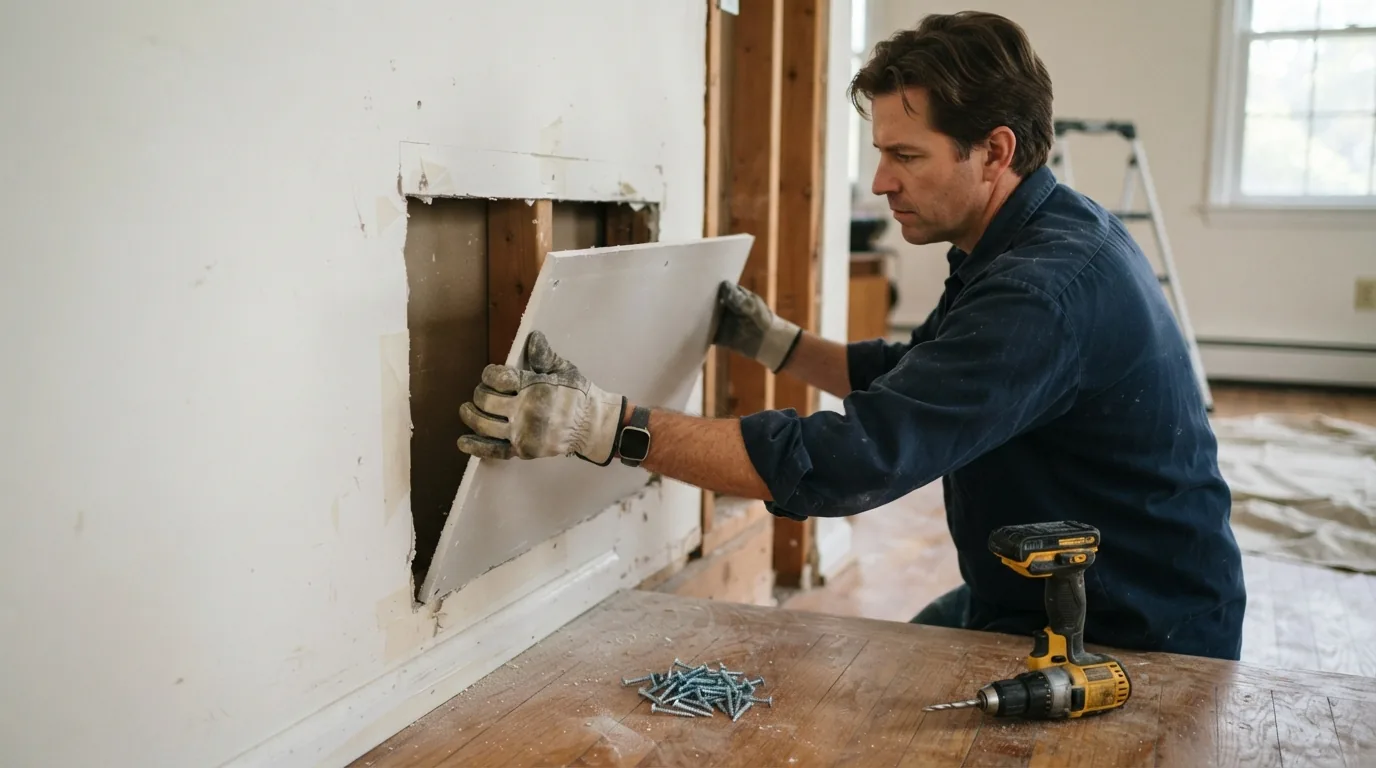
Once the hole is bigger than a patch can bridge — a foot through the wall, a plumber’s access cut, a doorknob that has gone through repeatedly in the same spot — you cut the damage back to a clean rectangle, add backing behind it, and fit a new piece of drywall into the gap. Then tape the seams and finish.
This is the option that separates a tidy job from an obvious one. There are now four seams where there were none, and each has to be feathered wide enough that light doesn’t catch the edge. Rushing this is why some repairs look fine in the evening and terrible on a bright Saturday morning.
Replace the sheet
Sometimes the honest answer. If a wall has taken repeated damage, has multiple old repairs, is water-damaged across an area, or has been patched by someone in a hurry, joining new work to bad old work costs more in labor than starting clean.
The rule of thumb I use: once you’re piecing in more than about a third of a sheet, or joining onto repairs you don’t trust, replacing is faster, flatter and usually cheaper by the time you count the finishing.
What actually decides it in this county’s housing stock
Montgomery County has an unusually wide age range of homes, and it changes the answer more than the damage does.
Inside the Beltway — Silver Spring, Takoma-adjacent streets, older Bethesda — you’ll frequently find lath and plaster rather than drywall. There, “patch or replace” isn’t even the right question, because plaster fails by losing its grip on the lath behind it rather than by breaking. A plaster wall that flexes under your palm needs re-securing before anything cosmetic, and no amount of compound fixes a section that’s quietly detaching.
Newer stock — the townhouse developments, Gaithersburg’s later subdivisions, anything from the 1990s on — is straightforward drywall, usually half-inch, and generally behaves the way the textbook says.
The awkward middle is 1950s to 1970s houses, where you get early drywall, sometimes thinner than modern board, often with textured ceilings. Matching a thinner old board with modern half-inch is a real detail, and getting it wrong leaves a step in the wall you’ll notice forever.
The one thing that overrides all three options
Moisture. If the drywall is damp, none of the three choices apply until you know why.
Wet drywall loses its structure permanently — it doesn’t recover the way timber does. And whatever wet it will keep wetting. I’ve re-done work where someone patched the same spot twice in a year while a slow leak carried on above it, which is a way of paying three times for one repair.
Find the source, fix the source, let it dry properly, then decide which of the three you need. In that order, always.
Before you sand: the pre-1978 question
A large share of this county’s housing predates 1978, which means the paint may be lead-based. Sanding drywall compound is harmless; sanding through into old paint layers is not, and contractors disturbing pre-1978 paint are required to be certified under the EPA’s Renovation, Repair and Painting Rule.
For a small patch it’s usually not in play. For anything involving cutting back, removing sheets or extensive sanding in an older home, it is — and it’s a fair thing to ask about before work starts.
What this means for what you’ll pay
I won’t put a figure on a blog post without seeing the wall. What I can tell you is where the money goes, because it surprises people: not the drywall. A sheet of drywall is one of the cheapest materials in your house.
The cost is labor, and specifically finishing labor — the coats, the drying time between them, the sanding, the priming, and usually painting a wider area than the repair so the paint matches. National cost guides put small patches in the low hundreds and larger work higher; treat those as market ranges rather than a quote from us.
Which is also why “just patch it” sometimes costs more overall. A patch on a wall that needed a piece cut in will show, and showing means doing it again properly, having already paid once.
The short version on drywall repair in Montgomery County
Drywall repair in Montgomery County is a choice between patching, piecing in and replacing the sheet — decided by whether the surrounding material is sound, not just by the size of the hole. Older homes inside the Beltway are often plaster, which fails differently and needs re-securing rather than filling. Moisture overrides everything: find the cause first. And the cost lives in the finishing, not the board.
If you’re not sure which of the three you’re looking at, that’s exactly the thing worth a second opinion — we do drywall and plaster work across Silver Spring and the county, and we’ll tell you if it’s a patch you could handle yourself. Free estimates, no obligation.
Frequently asked questions
Q: How big can a hole be before it needs more than a patch?
A: Roughly fist-sized is the practical limit for a straightforward patch, but the deciding factor is the drywall around it. Sound board takes a bigger patch than crumbling board does.
Q: Can you match a textured wall or ceiling?
A: Usually, though it’s the skilled part of the job rather than the slow part. If the texture is original and the house predates the early 1980s, have it tested for asbestos before anything is scraped or sanded.
Q: My repair looks fine at night and obvious in daylight. Why?
A: Because daylight rakes across the wall at a low angle and finds ridges that overhead lighting hides. It means the seams weren’t feathered wide enough. It’s fixable, and it’s the most common reason people call about work someone else did.
Q: Is it worth replacing a whole wall rather than repairing it?
A: Occasionally. If it carries several old repairs you don’t trust, or damage across a wide area, starting clean is often faster and flatter than joining onto work of unknown quality.
