
Somebody hangs a shelf, the anchor spins uselessly in the hole, and the wall crumbles into gray dust instead of white powder. That’s usually the moment a homeowner in an older Montgomery County house discovers their walls are not what they assumed.
Knowing whether you have plaster or drywall takes about a minute, and it changes almost everything about how a repair should be done. It is the first thing I check when I walk in, before I’ve even looked at the damage.
Why plaster or drywall changes the whole job
Drywall is a gypsum panel screwed to studs. You cut it with a knife, patch it with compound, and it behaves predictably.
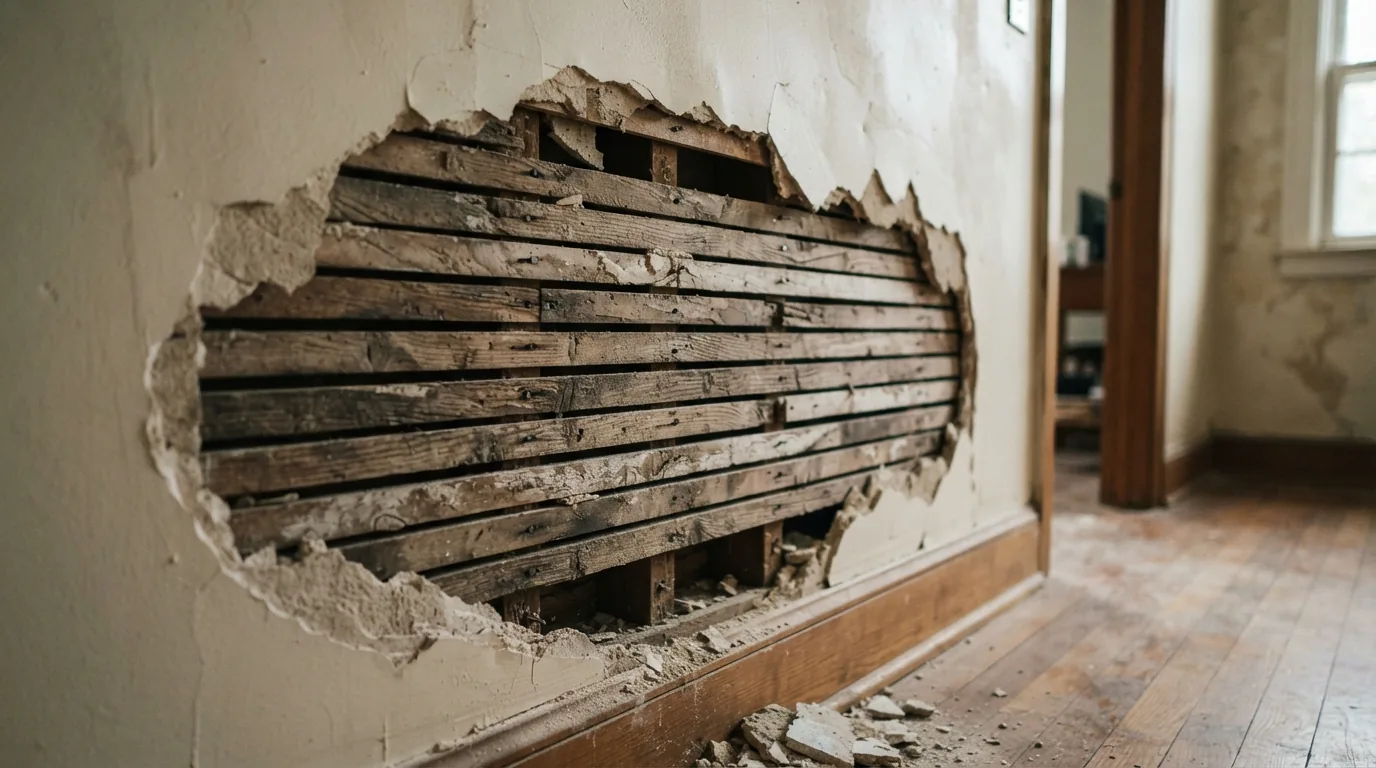
Plaster is a wet material that was troweled on in coats over wood lath — thin horizontal strips nailed across the studs. It squeezed through the gaps between those strips and hardened into little hooks on the far side. Those hooks are called keys, and they are the only thing holding your wall up.
That difference is why the same-sized hole is a different job. Drywall repair is mostly about finishing. Plaster repair is about not making it worse while you work, because hammering, drilling or aggressive sanding sends vibration through the wall and can snap keys several feet away from where you’re standing. People patch one hole and open two more.
Four ways to tell, fastest first
1. The pushpin test
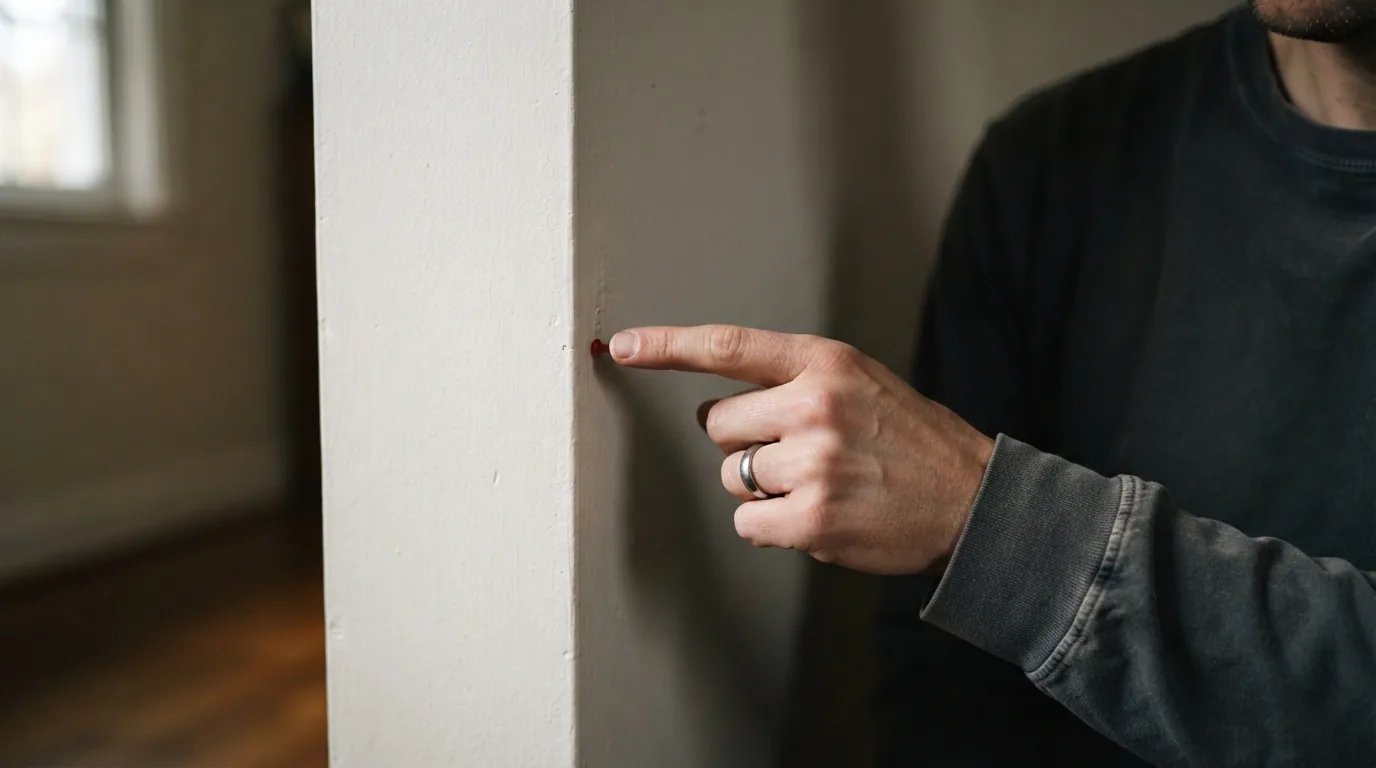
Push a pin into an inconspicuous spot. Into drywall it goes with thumb pressure alone. Into plaster it stops dead almost immediately. This is the quickest test there is and it’s right most of the time.
2. Knock on it
Drywall sounds hollow and a bit drummy between studs. Plaster sounds dense, solid and higher-pitched — less like a drum, more like knocking on a plate. Once you’ve heard the difference you don’t forget it.
3. Look inside an existing hole
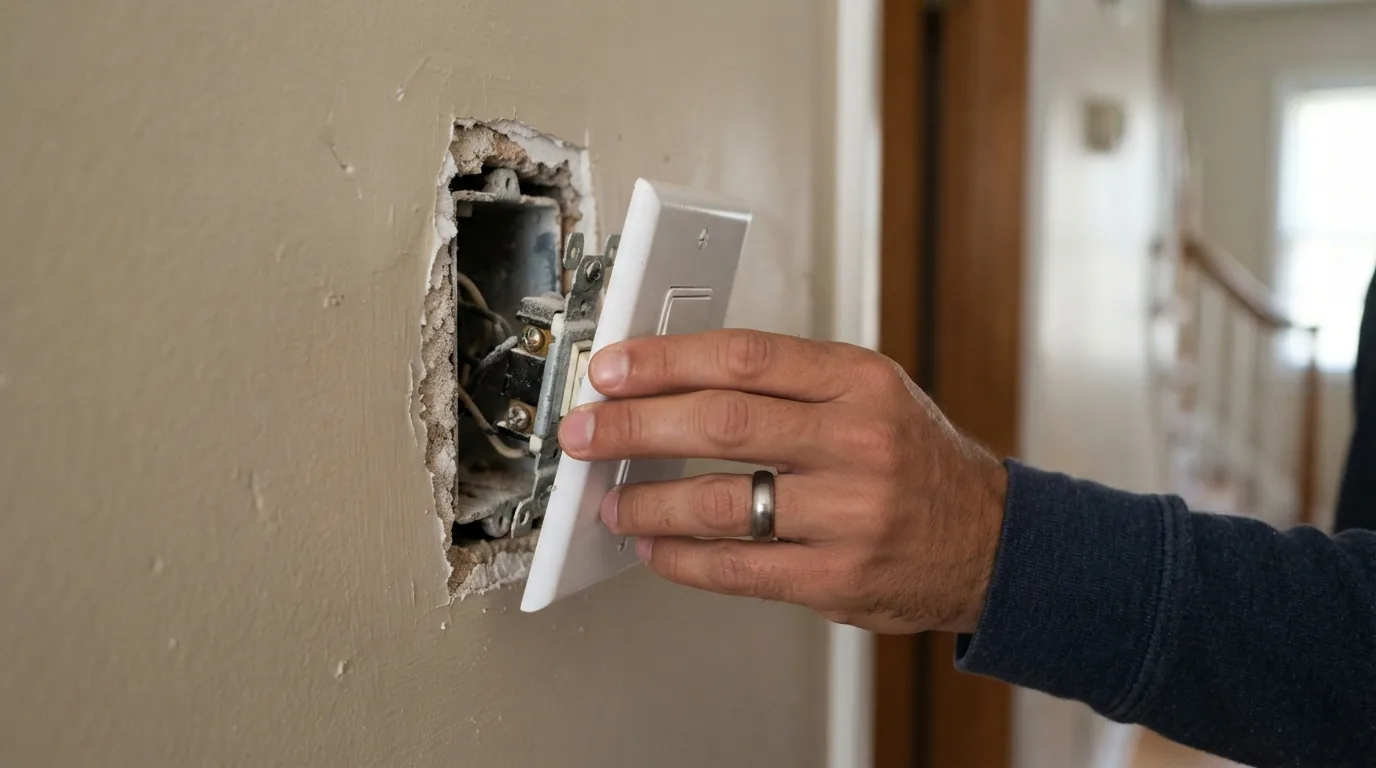
The most reliable check. Pull off a switch plate or an outlet cover and look at the cut edge. Drywall shows a paper face, a gypsum core and another paper face — a clean sandwich, usually a half-inch thick. Plaster shows a thicker, grittier edge with no paper at all, and often you can see wood strips behind it.
4. Check the age of the house
Not proof, but a strong hint, and across the Silver Spring streets we work on most the answer to plaster or drywall often comes down to the decade alone. Homes around here built before roughly the late 1940s are usually plaster. Post-war construction shifted to drywall through the 1950s, and by the 1960s it’s the default. Silver Spring inside the Beltway skews old enough that plaster is common. Newer stock further out — Fairland, parts of Aspen Hill, the townhouse developments — is drywall almost without exception.
Two caveats. Renovations mean plenty of houses are both: original plaster in the front rooms, drywall in a kitchen that got redone in 1998. And veneer plaster exists — a thin plaster skim over a special board — which looks like plaster and behaves partly like drywall. If the walls feel like plaster but the house is from the 1970s or later, that’s probably what you have.
What this changes about the repair
Once you know whether it’s plaster or drywall, the approach diverges:
- Anchors. Standard drywall anchors are close to useless in plaster — they need the expansion room that plaster’s hardness denies them. Plaster wants either a screw into the stud behind or an anchor rated for masonry-like material.
- Cutting. Drywall takes a utility knife. Plaster needs to be scored and cut with the right blade, and cut slowly, because speed means vibration and vibration means broken keys.
- Patching depth. Plaster walls are noticeably thicker. A drywall patch cut to sit flush in a plaster wall will sink below the surface and need building up in layers.
- Loose sections. A plaster wall that flexes when you press it has lost its keys. That has to be re-secured back to the lath before any cosmetic work — otherwise you’re skimming over a section that is quietly detaching.
The one thing to check before you sand anything
If the house was built before 1978, assume the paint may be lead-based until you know otherwise. Sanding is exactly the activity that turns intact paint into airborne dust, and plaster walls in older homes have had a lot of coats over the years.
The EPA’s guidance on lead in the home is worth ten minutes of reading if your house is in that age bracket, and contractors disturbing pre-1978 paint are required to be certified for it. It’s a reasonable thing to ask about — a straight answer is a good sign.
When plaster is worth keeping
People sometimes ask whether they should just tear it out and hang drywall. Occasionally that’s the right answer, when a wall is failing across most of its area.
Usually it isn’t. Plaster is harder, better at deadening sound between rooms, and in an older house it holds original detail — picture rails, plaster cornices, curved corners — that drywall cannot reproduce without a lot of money. A plaster wall that’s sound apart from some cracking is a wall worth repairing rather than replacing. I’ve seen beautiful original plaster ripped out on the theory it was “old”, and the room afterwards was flatter in every sense.
The short version on plaster or drywall
To tell plaster or drywall apart: push a pin in, knock on it, and look at the cut edge behind a switch plate. Drywall takes the pin easily and shows a paper-faced sandwich; plaster resists the pin, sounds solid, and sits over wood lath. It matters because plaster fails by vibration, needs different anchors and different cutting, and in pre-1978 homes brings lead-paint precautions with it.
If you’ve established what you’ve got and the repair still looks like more than an afternoon, we handle both plaster and drywall repair across the county — and we’ll tell you honestly if it’s a job you could do yourself. Free estimates, no obligation.
Frequently asked questions
Q: Can I hang a TV on a plaster wall?
A: Yes, but into the studs behind it, not into the plaster. Plaster will not hold that kind of load on anchors alone, and a failure takes a chunk of wall with it. Find the studs properly first — a magnet locating the lath nails works well in older walls where stud finders struggle.
Q: My walls are cracking everywhere. Is the house moving?
A: Usually not. Fine cracking across plaster is generally age and seasonal movement, and our humidity swing here is hard on it. Cracks that are widening, stepping diagonally, or accompanied by doors that no longer close are a different conversation and worth having someone look.
Q: Is it more expensive to repair plaster than drywall?
A: Generally yes, for the same size of damage — it’s slower, needs more layers, and needs care not to break more of it while working. The gap is smaller on small repairs and grows on large ones.
Q: What is veneer plaster?
A: A thin coat of plaster applied over a gypsum backing board rather than wood lath. It gives a plaster surface with a modern build-up, common from the 1970s onward. It’s harder than drywall but doesn’t have the keys-and-lath vulnerability of traditional plaster.
