

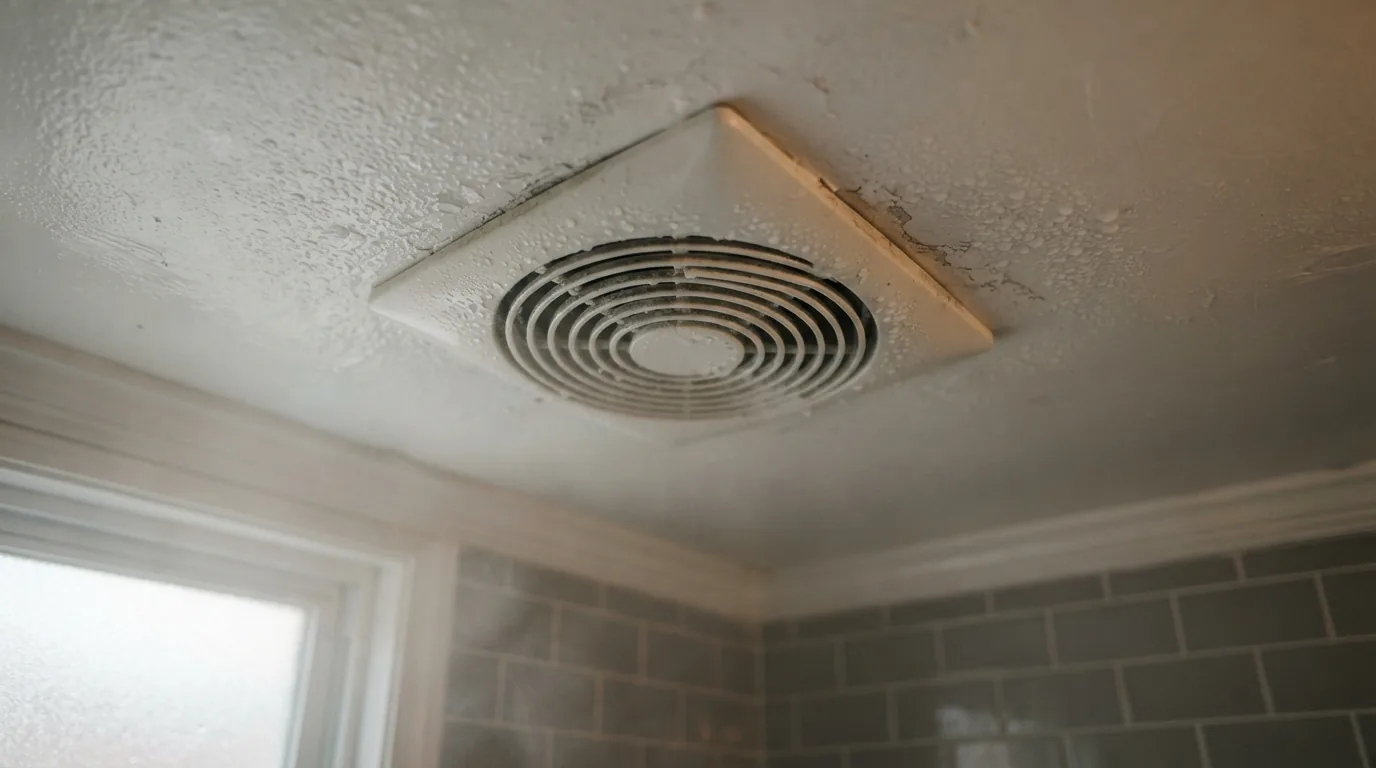
If I could change one thing in the average older bathroom around here, it wouldn’t be the tile or the vanity. It would be the fan.
Bathroom ventilation is the least glamorous line on any estimate and the one with the highest return. It’s also the defect I find most often — either there’s no fan, or there’s a fan that isn’t achieving anything, or there’s a fan quietly dumping warm wet air into the attic.
Why this region is hard on bathrooms
Mold needs moisture, a food source and time. Paper-faced drywall and wood framing supply the food. A shower supplies the moisture. What decides the outcome is how long the moisture hangs around.
Our summers do us no favours. When outdoor air is already carrying a lot of water, a bathroom clears far more slowly than it would in February — opening a window in August can actually bring more moisture in than it lets out. The EPA’s guide to mold and moisture in the home puts the useful number on it: dry damp materials within 24 to 48 hours and you generally prevent growth. Miss that window repeatedly and you don’t.
A bathroom used twice a day never fully dries out if the ventilation isn’t moving air.
The three bathroom ventilation failures I actually find
1. No fan at all
Common in bathrooms with a window, on the reasoning that the window is the bathroom ventilation. It isn’t, for the reason above, and because nobody opens a window in January.
2. A fan venting into the attic
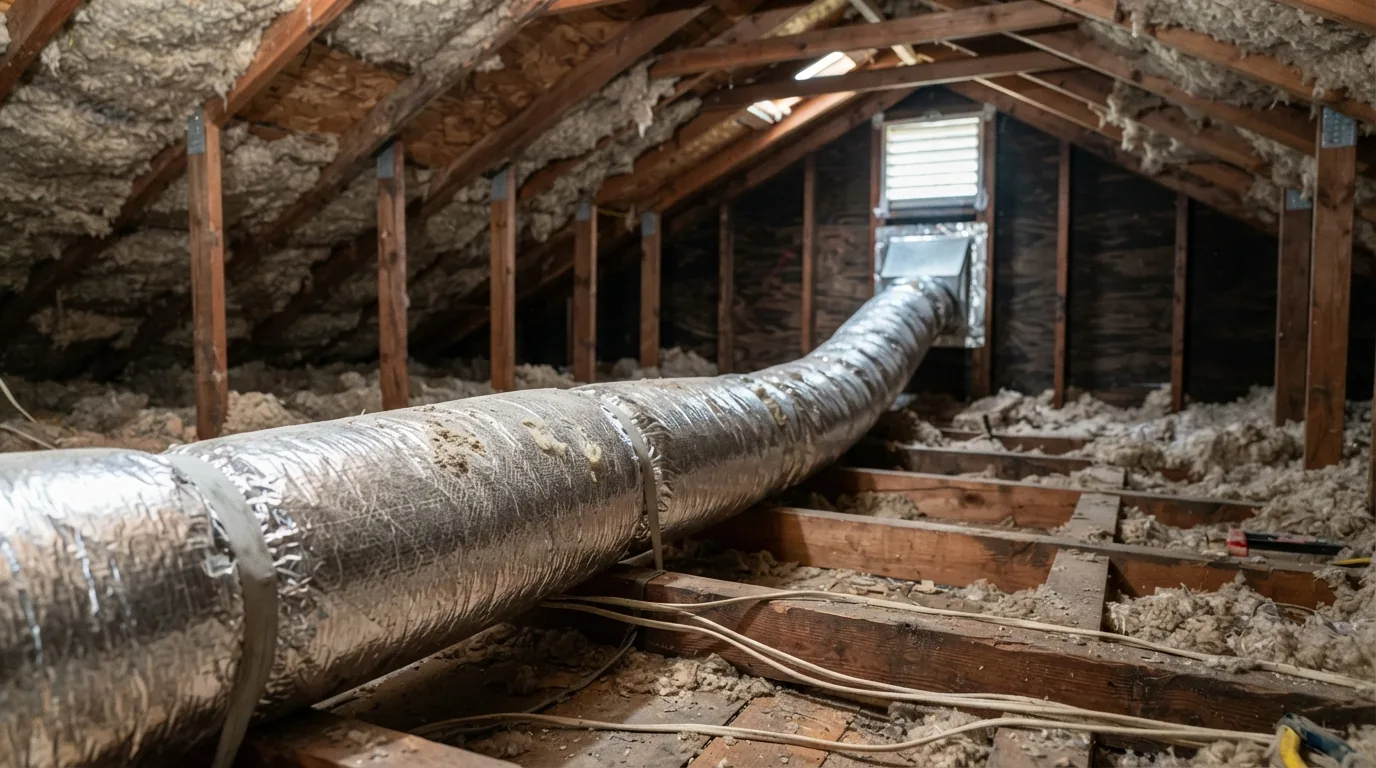
This is the worst of the three, and it’s surprisingly common. The fan works, the bathroom clears, everyone’s happy — and every shower deposits warm moist air into a cold attic where it condenses on the underside of the roof.
The bathroom is fine. The attic slowly isn’t. I’ve seen sheathing gone dark and soft above a bathroom whose owner thought their ventilation was excellent. A duct has to terminate outside the building — through the roof or a gable wall — not merely leave the bathroom.
3. A fan that’s too small, too far away, or too clogged
Fans are rated in CFM, and the rough rule for a normal-sized bathroom is roughly one CFM per square foot, with a sensible minimum of about 50 CFM. Bigger rooms and rooms with separate enclosed toilets need more.
But rating is theoretical. Real airflow depends on the duct: long runs, flexible duct that sags, crushed sections and multiple tight bends all cut it drastically. A 110 CFM fan on a bad duct can move less air than a 50 CFM fan on a short straight one.
And they clog. A fan that hasn’t been cleaned in a decade is largely decorative.
The tissue test
Simplest check there is. Turn the fan on, hold a single sheet of toilet paper against the grille and let go.
It should hold there firmly. If it holds weakly, your airflow is poor. If it falls, the fan is either broken, disconnected, or so clogged it’s doing nothing. It takes five seconds and tells you more than the fan’s label does.
Second check: go into the attic and confirm the duct actually leaves the building. People are routinely surprised.
What good bathroom ventilation looks like
Good bathroom ventilation is correctly sized for the room. Ducted in rigid or semi-rigid duct, as short and straight as the layout allows, insulated where it crosses a cold attic so the moisture doesn’t condense inside the duct itself. Terminating outside with a proper hood and a backdraft flap.
And run long enough. The fan needs to keep going after the shower stops — twenty minutes or so — which nobody does manually. A timer switch or a humidity-sensing switch solves it permanently for a modest cost, and it’s the single upgrade I recommend most often.
If you already have mold
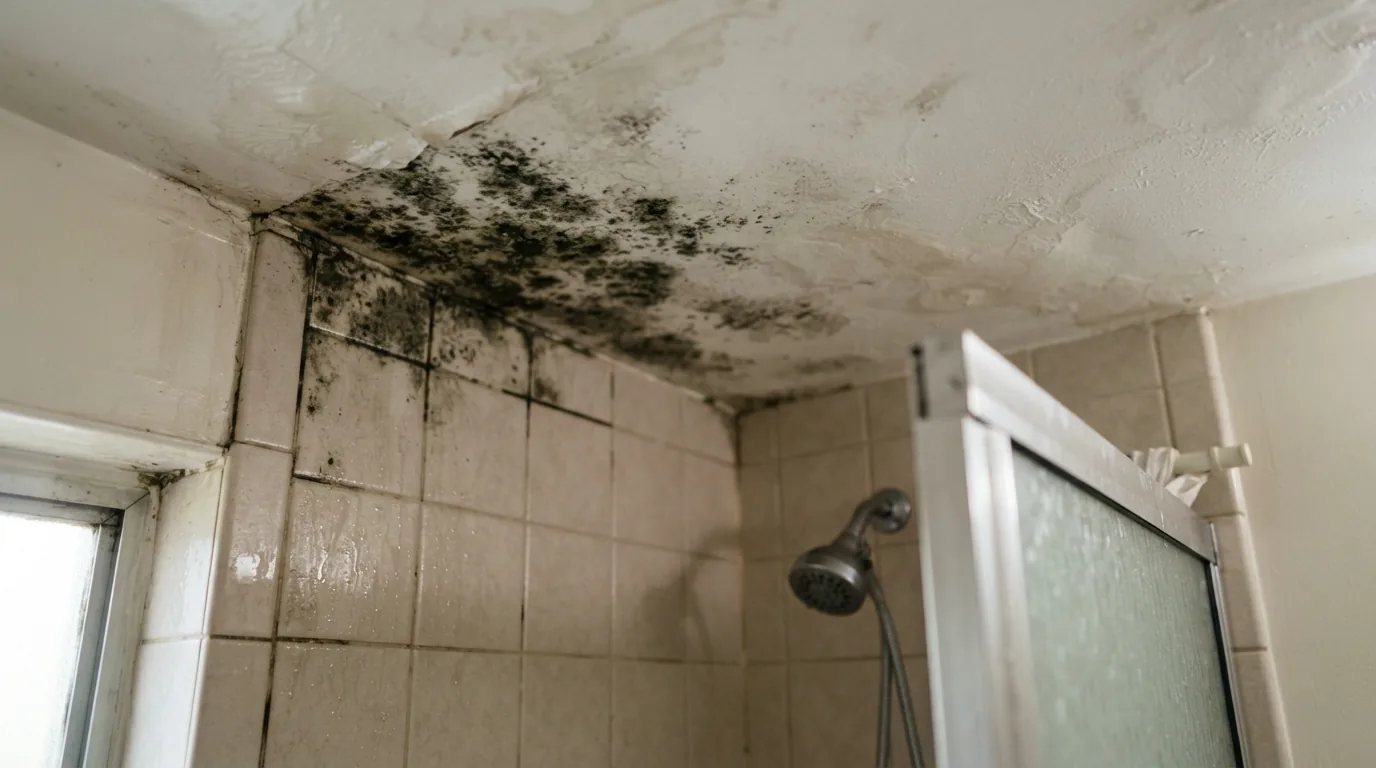
Small areas on hard surfaces can be cleaned. Anything beyond a modest patch, anything recurring, and anything on porous material that has stayed wet — that’s a different job, and painting over it achieves nothing but a short delay.
The important part is that mold is a symptom. Clean it without fixing the ventilation and it comes back on the same schedule.
The short version on bathroom ventilation
Bathroom ventilation is the cheapest high-value item in any bathroom, and the most commonly defective. The three failures are no fan, a fan venting into the attic rather than outside, and a fan crippled by a long or crushed duct. Test yours with a sheet of toilet paper, and check in the attic that the duct actually leaves the building. Add a timer or humidity switch so it runs after the shower — that one change prevents more problems than anything else on the list.
If you’re not sure what yours is doing, it’s a quick thing to check while we’re there for something else. Bathroom work across Silver Spring and the surrounding neighborhoods, free estimates, no obligation.
Frequently asked questions
Q: Do I need a fan if my bathroom has a window?
A: In this climate, yes. Humid summer air doesn’t dry a bathroom, and nobody opens the window in winter. A window is a supplement, not a substitute.
Q: How long should the fan run after a shower?
A: Around twenty minutes. Since nobody remembers, a timer switch or a humidity-sensing switch is a small cost that makes it happen automatically.
Q: Can a fan vent into the attic if the attic is well ventilated?
A: No. It should terminate outside the building envelope. Discharging into an attic deposits moisture onto roof sheathing, and that damage is slow, hidden and expensive.
Q: My fan is loud. Does that mean it’s powerful?
A: Usually the opposite. Noise is rated in sones, separately from airflow in CFM. Quiet modern fans frequently move more air than older noisy ones — the noise is just an inefficient motor.
