

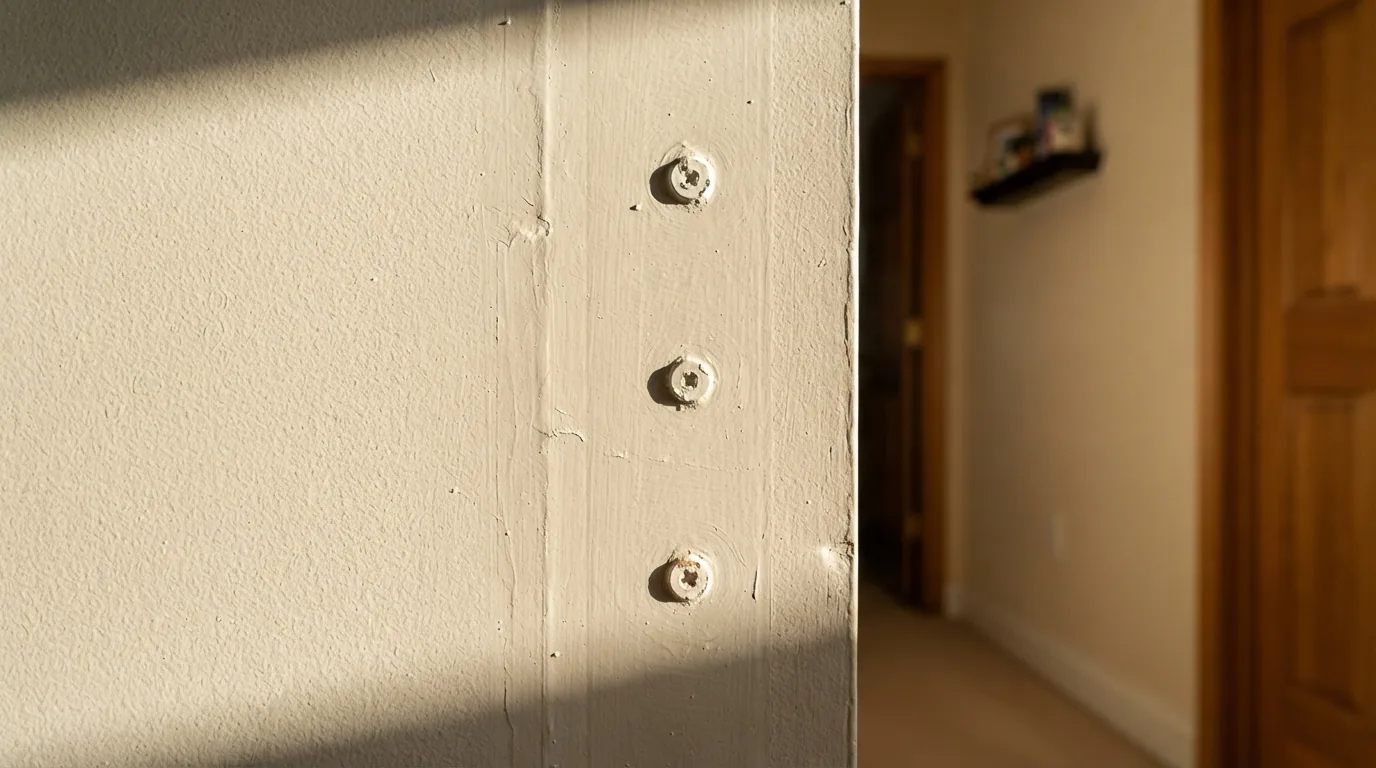
Every so often someone sends me a photo of a wall with three small circular bumps in a vertical line and a message that just says “is this bad?”
Almost always: no. Nail pops in drywall are one of the most common things in any house more than a couple of years old, and in the overwhelming majority of cases they’re telling you about timber, not about your foundations.
What nail pops in drywall actually are
Drywall is fixed to timber studs. Timber is a natural material that takes on moisture in humid months and gives it up in dry ones, so it swells and shrinks very slightly, over and over, for the life of the house.
Each cycle moves the timber a fraction against the fastener. Do that a few hundred times and the nail or screw head works its way back out, pushing the compound covering it into a small dome, which eventually cracks and flakes off. That’s the bump you’re looking at.
Our climate here is close to ideal for producing them — February indoor air is dry, August is anything but, and that annual swing is exactly the driver.
Reading the pattern
What matters isn’t that you have them. It’s how they’re arranged.
- A vertical line of them, evenly spaced. That’s a single stud doing what timber does. Cosmetic.
- Scattered singles around the house. Normal ageing, especially in the first couple of years after construction while framing timber finishes drying out.
- A cluster in one small area with no pattern. Usually something behind it — a poorly seated fixing, or vibration from a door that slams.
- Pops appearing alongside doors that have stopped closing, diagonal cracks from window corners, or sloping floors. That combination is worth an opinion from a structural engineer rather than a handyman. Not because pops are serious, but because the company they’re keeping might be.
That last one is the honest dividing line. On its own, a nail pop is a finishing issue. Alongside doors binding and stepped diagonal cracking, it’s a data point in a bigger picture.
Corner bead: the other bump people worry about
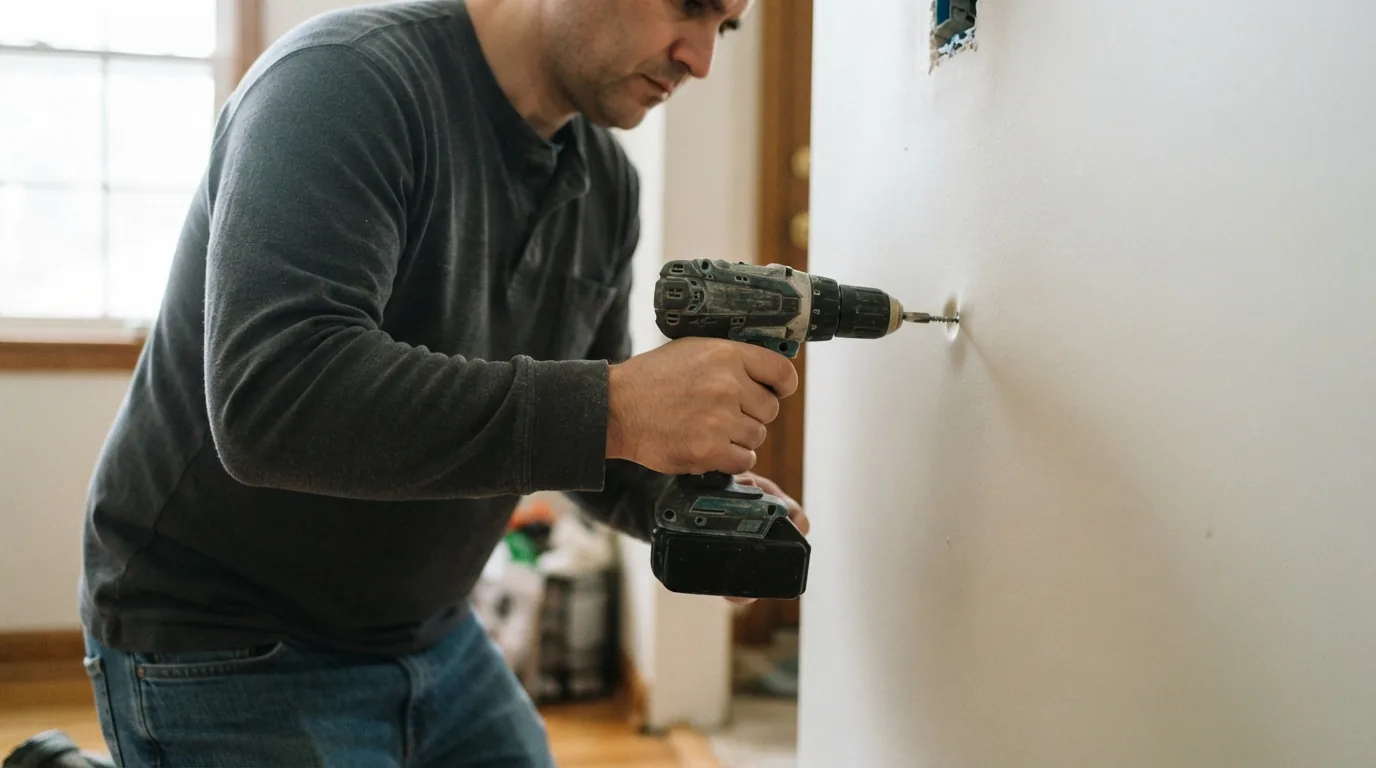
Corner bead is the strip that forms the crisp edge on an external corner — the corner of a wall that sticks out into a room. Metal bead is common in older work, paper-faced or vinyl in newer.
When it fails you get a long crack running down the corner, sometimes with the compound flaking away in strips. Causes are usually one of three: the bead was fixed too far apart and flexes, something heavy has caught the corner, or in the case of metal bead in an older house, it’s rusted from the inside after a damp episode and expanded.
Corner damage takes more skill than a flat patch, because a corner is the one place on a wall where the eye instantly detects a line that isn’t straight. It also can’t be sanded aggressively — you sand the edge off the corner and it looks soft and rounded forever.
Hairline cracks and what they mean
Fine cracks are so common they’re almost a feature. Where they appear is what tells you something:
- From the corner of a door or window frame, at roughly 45 degrees. Very common. The opening is a weak point and normal seasonal movement concentrates there. Nearly always cosmetic, but it will come back if it’s only filled — it wants tape.
- Along a ceiling-wall junction, opening in winter, closing in summer. Truss uplift. Seasonal. Cosmetic.
- Straight vertical or horizontal, following a seam. A taped joint that’s moved.
- Stepped, widening, in a masonry wall, or wide enough to slide a coin into. Different conversation. Get it looked at properly.
The fix that actually holds
For a nail pop, the tempting approach is to knock the bump flat and fill it. That fails, because the fastener is still loose and it will simply come back out.
What works: drive a new screw about an inch or two above or below the popped fastener, into the same stud, pulling the board tight to the timber. Then either remove the old fastener or drive it back below the surface. Then fill both, in thin coats, and sand lightly.
Two screws and two small filled spots instead of one — slightly more visible work, dramatically less likely to reappear. Skipping the new screw is why some walls get the same three pops fixed every couple of years.
For hairline cracks at door corners, the same principle applies: filler alone reopens. It needs the crack opened slightly, taped, then finished. Slower, and it stays gone.
What’s fair to do yourself
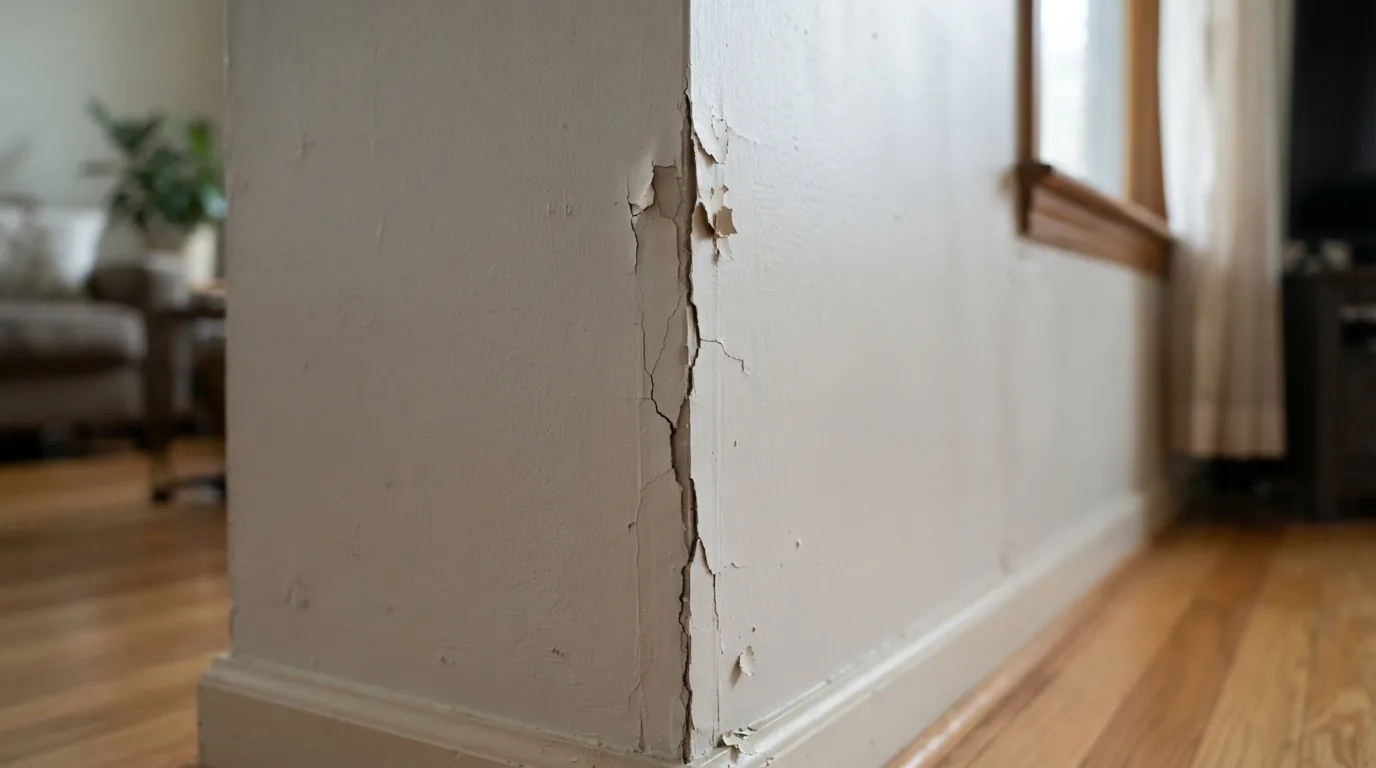
This is genuinely good DIY territory. A screwdriver, a putty knife, lightweight compound and fine sandpaper will handle nail pops in drywall across a whole house for the price of a takeaway.
The two mistakes to avoid are loading compound on thick — it cracks as it shrinks — and sanding hard, which digs a shallow dish around your repair that then needs filling. Thin coats, light sanding, patience. And if the house predates 1978, don’t sand through into old paint; the EPA’s lead guidance is worth reading first.
The short version on nail pops in drywall
Nail pops in drywall are almost always seasonal timber movement working a fastener loose, not a structural problem. A vertical line of them is one stud behaving normally. They only warrant concern alongside binding doors, stepped diagonal cracks or sloping floors. The fix that lasts adds a new screw into the same stud rather than just refilling the bump.
If you’ve got a wall doing several of these at once and you’d rather it was just handled, it’s a straightforward job for us and we cover Silver Spring and the surrounding neighborhoods. Free estimates, and we’ll say so if it’s a job you could do in an afternoon.
Frequently asked questions
Q: Are nail pops a sign of foundation problems?
A: On their own, no — they’re normal timber movement. They matter when they show up alongside doors that no longer close, diagonal stepped cracking, or floors that have gone out of level. That combination is worth a structural opinion.
Q: Why do they keep coming back in the same place?
A: Because the loose fastener was filled over rather than dealt with. Unless a new screw pulls the board back tight to the stud, the old one keeps working its way out.
Q: My new build has lots of them. Is that normal?
A: Unfortunately yes. Framing timber continues drying for a year or two after construction, and that first drying cycle produces the most movement. Many builders expect a snagging visit for exactly this.
Q: Can corner bead be repaired, or does it need replacing?
A: Both happen. A short damaged section can be cut out and pieced in. Rusted metal bead in an older home usually wants replacing along its length, because the rust keeps expanding and will crack any repair over it.
